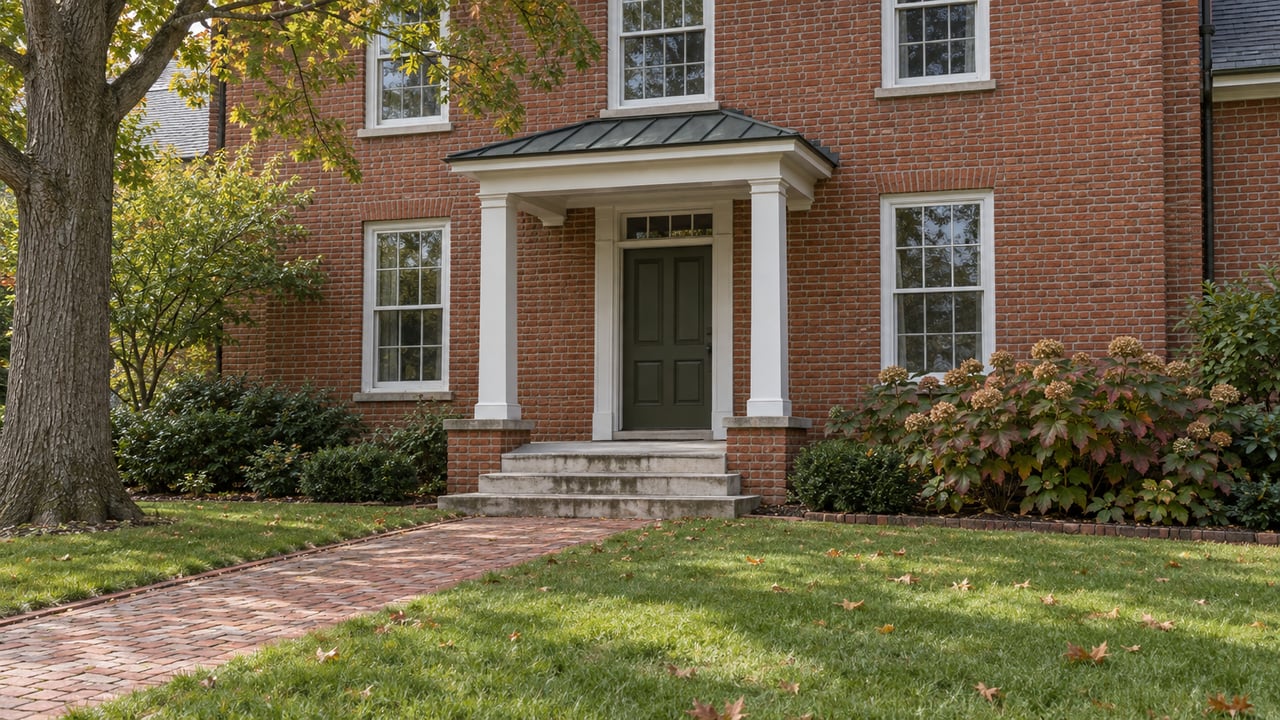
Roswell's Historic District Runs on Two Maps. Which One Is Your House On?
November 5, 2026
November 5, 2026
Suppose you buy a 1920s cottage off Mimosa Boulevard, close in January, and have a contractor replacing rotted siding by February. Have you just spent your tax credit before you applied for it?
Since January 1, 2026, the answer can be yes for many more Roswell homes than before. That's the date Georgia's Historic Home income tax credit opened to owner-occupied primary residences that are locally designated or that contribute to a local historic district. The program is set up to review a project before work begins, so whether you claim it depends on the order you do things in.
Inside Roswell's local historic district, any exterior material change needs approval from the city's Historic Preservation Commission. That includes new buildings, changes to how an existing building looks, demolition or moving a structure, and changes to external environmental features. The state credit runs through a different office, the Historic Preservation Division at the Georgia Department of Community Affairs, which has its own review. For a buyer who plans to renovate, the two tracks run side by side:
A COA from the city does not stand in for state certification, and the reverse is also true. Someone closing on a historic Roswell home with renovation plans is effectively working to two calendars at once.
The city's first historic zoning came in 1971. That H-R district covered Bulloch Avenue, Barrington Hall and most of Mimosa Boulevard. In May 1974, the National Park Service listed a slightly larger Roswell Historic District on the National Register of Historic Places that also took in Roswell Mill Village and Town Square. NPS lists that district under reference number 74000682 with a date of May 2, 1974.
The local district then grew. Mayor and Council adopted a redesigned historic district map on May 16, 1988. According to the city's Historic Preservation Commission StoryMap, the federally listed district now sits entirely inside the locally designated one. Roswell also has four individually listed National Register properties: the Archibald Smith House, Barrington Hall, Bulloch Hall and the Methodist Cemetery.
That leaves three kinds of address in and around the historic core: homes inside both boundaries, homes inside the 1988 local boundary only, and homes outside both. The city publishes both maps, the Historic Properties Map for the local district and the National Register District Map. Checking a parcel against both before writing an offer takes a few minutes.
Before the expansion, the state income tax credit depended on the National or Georgia Register. A property had to be listed or eligible, either on its own or as part of a Register district. Senate Bill 496, signed on April 18, 2024, added a second route for owner-occupied homes. DCA began accepting applications on October 1, 2025, and locally designated projects could not start work before January 1, 2026.
Because Roswell's federal district sits inside its local one, the new route makes the biggest difference for homes in the area the 1988 map added. Those homes already went through commission review. Now that review district can also be the basis for a state credit.
| Inside the 1974 National Register district | Inside the local district only | |
|---|---|---|
| HPC approval for exterior changes | Required | Required |
| Historic Home income tax credit | Through Register status | Through the local-district route, open since January 1, 2026 |
| Preferential property tax assessment | Possible through Register status | Not available through local designation alone |
| City confirmation form with Part A | Not part of the Register route | Required |
The property tax row matters. DCA's preferential assessment program freezes the county assessment for about 8.5 years, but it depends on Register eligibility and a 50 to 100% increase in the building's fair market value, depending on use. DCA states that a property qualifying only through local designation is eligible for the Historic Home credit alone. Two houses a block apart, with the same commission review, can still have different incentives available.
According to DCA's program page, the credit equals 25% of qualifying rehabilitation expenses and is capped at $100,000 for a principal residence. DCA's fact sheet adds that a home in a target area, as state law defines it, may get 30%, with the same $100,000 cap. To qualify, a project has to pass a "substantial rehabilitation" test. For a historic home used as a principal residence, qualified expenses must exceed the lesser of $25,000 or 50% of the building's adjusted basis. At least 5% of qualified spending has to go to exterior work. Acquisition costs and new construction don't count.
Here is the arithmetic. A homeowner who spends $80,000 on qualifying work would be looking at a credit of $20,000 at the standard 25% rate. Under that structure, the $25,000 ceiling on the threshold means a mid-size kitchen-and-systems renovation on an older house can clear the test. The exterior requirement means at least $4,000 of that $80,000 would have to go to the outside of the house.
There is also a rule for resale. Under the Georgia statute as published by Justia, an owner who claims the credit and sells within three years faces recapture. The amount is capped at the profit from the sale and steps down from up to the full credit in the first year to two-thirds in the second and one-third in the third. Sales caused by the owner's death are exempt. For anyone timing a move, the date the credit was claimed now affects net proceeds along with the purchase price.
This post is general information, not legal, tax or financial advice. Questions about eligibility should go to DCA at [email protected] and to your own tax professional.
The design guidelines the city links today are dated May 12, 2014. They name the downtown character areas: Upper and Lower Canton Street, Town Square, Mill Village, Mimosa Boulevard, Alpharetta and Atlanta Street, and Groveway.
On October 27, city staff presented a proposed Historic District Style Guide. Citizen Portal reported that it is meant as a public visual library of materials, fixtures and neighborhood character, intended to make design reviews faster and more consistent. It would supplement the existing Unified Development Code guidelines. The same night, council initiated three UDC text amendments to reference the guide, including in Sections 13.6 and 13.7 on design plans and historic review. According to Citizen Portal's account, Planning and Zoning Director Jenny Peyton explained that the guide would take the place of a missing "pre-approved list," giving staff and applicants consistent administrative criteria.
For homeowners, that change is mostly about the staff-level Minor COA path, where a written list of acceptable materials helps most. The draft goes to the HPC on November 12 and to the Planning Commission for code updates on November 17. Staff then plans to publish a designed PDF and run a three-month evaluation period. Until those steps are finished, it remains a proposal.
Residential cases keep moving through the commission in the meantime. The October 14, 2026 HPC agenda included a request for a Certificate of Appropriateness for a rear addition and exterior renovation on Alpharetta Street. That kind of project is what a buyer of an older house near the core is likely to bring before the commission.
Does a house inside the National Register district escape city review? No. The federal district sits entirely inside the local district, and the commission reviews exterior changes throughout the local district.
Can a project started in 2025 use the local-district route? DCA's notice says rehabilitation work on locally designated projects could not begin before January 1, 2026.
Does the purchase price count toward the threshold? No. DCA excludes acquisition costs from qualified rehabilitation expenses.
Is the new style guide in effect? Not yet. It was presented on October 27 and is scheduled for HPC review on November 12 and Planning Commission review on November 17.
If you're thinking about buying or selling a home near Canton Street, Mimosa Boulevard or Mill Village, the right time to check which map a house is on, and what that means for the renovation and resale timeline, is before you sign the contract. The Lindsay Levin team can work through that timeline with you and connect you with the preservation and tax professionals who confirm the details.
Stay up to date on the latest real estate trends.

A Local Agent’s Guide to the Best Brunch Spots in Atlanta, GA.

A Guide to Move Managers and How They Make Downsizing in Buckhead Easier.
Understanding the SRES Designation and Why It Matters When You Buy or Sell in Atlanta.

A Local Guide to the Best Places to Buy Locally Roasted Coffee Beans in Atlanta.
downsizing
A Guide to Making Your Next Move With Confidence in Atlanta, GA
We pride ourselves in providing personalized solutions that bring our clients closer to their dream properties and enhance their long-term wealth. Get assistance in determining current property value, crafting a competitive offer, writing and negotiating a contract, and much more. Contact us today to discuss all your real estate needs!

LINDSAY LEVIN TEAM
3744 ROSWELL RD NE ATLANTA GA 30342